Low-Voltage Landscape Lighting Installation in Solano, Napa & Sonoma County
We install low-voltage LED landscape lighting in Solano County, Napa County and Sonoma County, and the wiring is worked out before anyone digs: how much the transformer carries, how much power reaches the last light, and where every cable runs and how deep. Then the system is lit at dusk, aimed and walked with you.
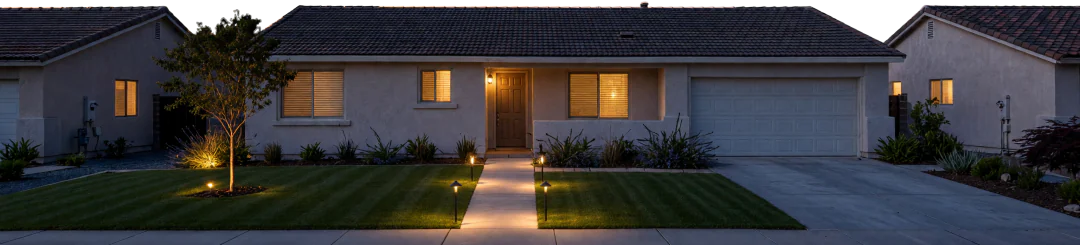
The landscape lighting completely improved the look of the property at night

What goes in the ground?
Cable rated for direct burial, buried where it crosses the lawn and run under the beds to each light. Every splice goes into a waterproof connector. A hub layout also gathers the splices into one box instead of scattering one beside every fixture in the lawn, so there are fewer joints to fail and one place to test them.
Sprinkler wiring on our irrigation jobs gets the same sealed splices. The transformer mounts on the wall beside an outdoor outlet.
3-year warranty on qualifying irrigation and lighting systems.
On at dusk, off at the hour you pick.
A photocell turns the system on at dusk. Each home run lands on the transformer separately, so a timer or app can switch the front and the back off at different times.
So the path and entry lights can stay on for a late arrival while the trees and walls go dark at bedtime. If your town sets a lights-out hour, the plan follows it: in Windsor, the Town limits how bright, what color and how late outdoor lights can run. Checked Oct 2026.
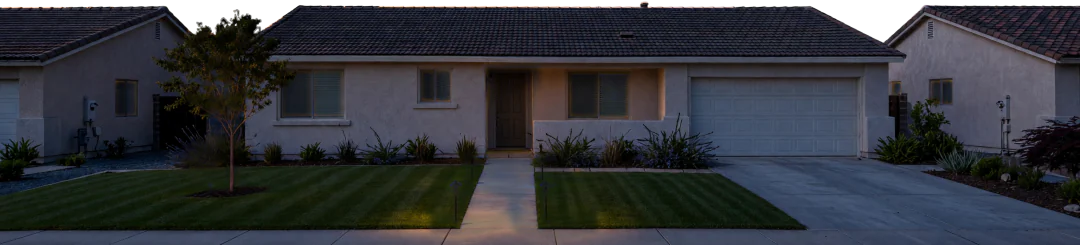
Sample evening; the photocell follows the season, so dusk moves.
How big should the transformer be?
Big enough that all the lights together use no more than 80% of its rating.
The rest is room for lights added later. Add the back yard below and watch the load: on the sample front yard’s transformer it passes that line, so the back yard gets a larger transformer or a second one.
Why do the last lights on a cable go dim?
Every foot of cable loses a little power, and on a single chain the last light loses the most.
A daisy chain runs one cable from light to light, so each fixture gets a little less than the one before. On the ten-light front yard below, that holds. Add the back yard to the same cable and the far lights get less than 10 volts; LED lamps are rated for 10 to 15, so they dim or flicker.
A hub layout runs one heavier cable to a box in a bed, then a lead of the same length to each light, so every light gets the same power. The layout your yard gets goes on the plan from Assessment & design.
How hard the transformer works
Room to grow. New lights can join later.
Daisy chain, front yard only.
Sample yard drawn for this page, not a customer’s: the same front yard as the plan on Landscape lighting, with example LED wattages.
Before the install.
At least 6 inches under the lawn.
Less where the cable rises to a fixture, more where it crosses a driveway. A driveway or patio crossing is planned before anyone digs.
Yes, if the transformer has room.
We size the transformer so the lights use no more than 80% of its rating, which leaves that room. If an older one is near its limit, a second transformer carries the new lights on their own zone.
Plan the wiring, then dig.
Tell Carlos what you want lit, and where the outlet is.
Call for a free quote(707) 329-8391