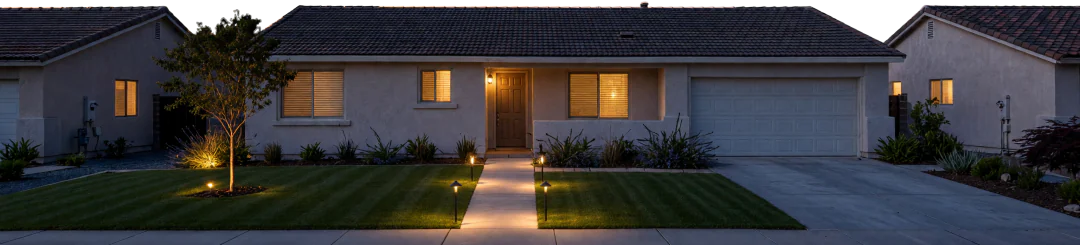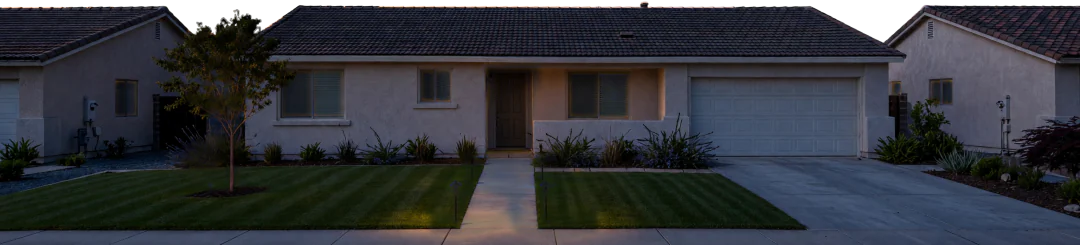
Landscape Lighting Maintenance & Upgrades in Solano, Napa & Sonoma County
When landscape lights go dark, the bulb is only one suspect. We trace the fault from the outlet to the last fixture: transformer, timer, every connection and the cable between. Then we repair the cause, move halogen systems to LED where the fixtures allow, and re-aim every light at dusk.

Why do landscape lights go dark?
Which lights are out tells you where to look. All of them points to the power; one run points to a connection; dim lights at the far end point to the cable. Pick what you’re seeing, and the drawing marks where we check first.
Every light on. Pick what you’re seeing above: the lights it puts out go dark, and the places we check first turn blue.
Should an older halogen system go LED?
Yes, when the fixture bodies are sound.
An LED lamp uses a fraction of a halogen lamp’s power and lasts several times as long. On the example twelve-light system here, the load falls from 240 to 60 watts of a 300-watt transformer, leaving room for new lights. Choose the color on purpose: early LEDs ran blue, and warm white keeps halogen’s look. Sound fixtures keep their housings and get new lamps; cracked or flooded ones are replaced.
We repair and upgrade lighting across Sonoma County too, and right now repairs are what we’re scheduling first there. In Windsor, the Town limits how bright, what color and how late outdoor lights can run, so on a Windsor upgrade we ask Windsor Planning first. Checked Oct 2026.
What happens on a lighting service visit?
Half of it happens in daylight, half after dark.
In daylight
We open the transformer, measure its load against its rating, and test the breaker, photocell, timer and backup battery. Every connection is checked; any that has let water in is replaced and sealed. Lenses get cleaned, buried fixtures dug out, leaning ones re-staked, and a spray head fouling a fixture is turned: the same crew works on irrigation.
At dusk
The system comes on and we walk each zone, aiming every light back at its target: trees keep growing after a plan is drawn, so an uplight set for a young canopy drifts down the trunk. Then the timer is set for the season, and you get a note of what we found.
Adding lights, not only fixing them? Start with Assessment & design, or see Low-voltage installation.
…explain any possible complications to clients before they arise when it comes to Low Voltage Lighting System…
The landscape lighting completely improved the look of the property at night
PICHIN PLATA · Google review, Jul 2026 (opens in a new tab)
…gave us suggestions for things we weren't very sure on
stephanie s · Google review, 2024–25 (opens in a new tab)
Before you call about your lights.
Start at the power.
Check the outdoor outlet the transformer plugs into: it should be GFCI-protected, and a tripped one resets with its button. Then check the transformer’s own breaker, and the timer, which can lose its time in an outage. If the breaker trips again straight away, there’s a short in the cable that needs tracing.
Once or twice a year.
Spring and fall: the clocks change in March and November, timers drift, and a season of growth has moved plants into the beams. Between visits, a light that’s out, dim or on at the wrong hour is worth a call, because one bad connection can take out every light after it.